
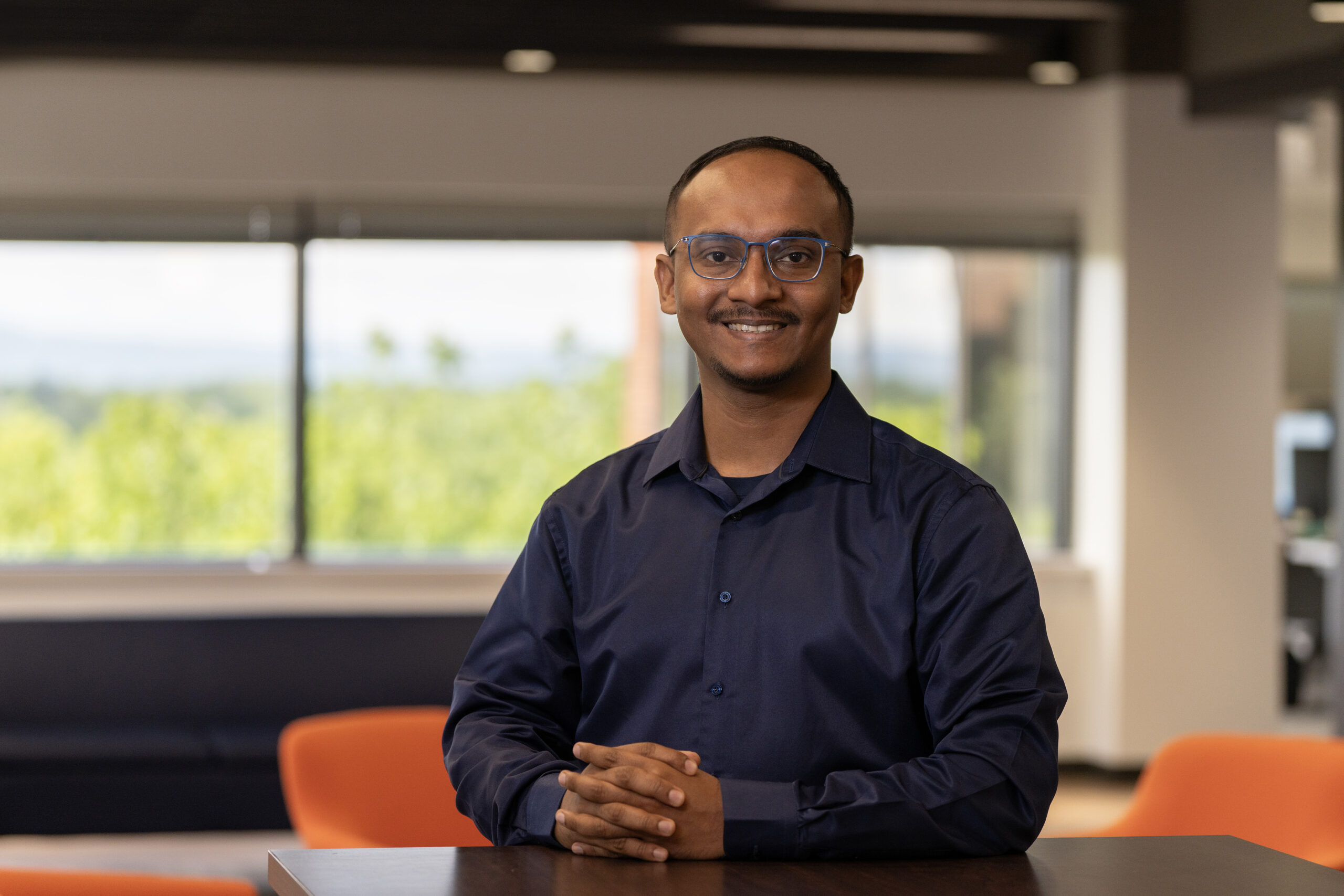
How Rashed Rahman, PhD, is advancing geotechnical innovation.
What if one of today’s toughest infrastructure challenges could be addressed using solutions found in nature?
That question has driven much of the research conducted by Rashed Rahman, a geotechnical engineering designer at Colliers Engineering & Design. His recently published research, Extracellular Polymeric Substances From Psychrophiles Regulate Ice Crystal Growth and Thermal Hysteresis to Enhance Frost Resistance, examines how substances produced by cold-loving bacteria may help reduce damage caused by freeze-thaw cycles, a persistent challenge for infrastructure in colder climates. His work explores how naturally occurring microorganisms can help improve soil performance in cold environments.
An Icy Idea
Rashed’s journey began while pursuing graduate studies at South Dakota Mines in Rapid City. The university specializes in engineering, science and technology. Rahman was searching for a research topic that would allow him to combine innovation with real-world impact. During conversations with his academic advisor, he was introduced to an unusual concept: psychrophiles, microorganisms that thrive in extremely cold environments. The idea immediately captured his attention because, at the time, Rashed had never seen snow.
What started as scientific curiosity quickly became a deeper investigation into a global infrastructure problem. After experiencing winter firsthand, he witnessed the effects of freeze-thaw cycles on roads and pavements and began to understand the significant challenges engineers face in cold regions.
The First Snow
Rashed’s research focused on extracellular polymeric substances (EPS), naturally produced materials that help microorganisms survive harsh conditions. His latest study explored how these biological compounds influence ice crystal formation and thermal behavior, helping improve frost resistance in soils and other materials exposed to freezing temperatures. The findings suggest that biological solutions may offer a promising new tool for mitigating freeze-thaw damage while supporting more sustainable engineering practices.
What makes Rashed’s work especially notable is its interdisciplinary nature. Trained as a geotechnical engineer, he found himself immersed in microbiology, learning how biological processes can influence soil behavior and infrastructure performance.
“When I was in high school and undergrad, I never considered myself a biology person,” Rashed said. “Now I understand bio-geotechnics, or how bacteria and biological processes can strengthen soils and improve performance.”
The research also reinforced the value of looking beyond conventional approaches. Rashed describes the work as “out-of-the-box” science, blending concepts from multiple disciplines to solve longstanding engineering challenges. According to him, some of the results revealed benefits researchers had not originally anticipated, including potential improvements in soil strength alongside enhanced frost resistance.
Continued Research
Although the core research was completed during his PhD studies, Rashed has continued writing and publishing his findings after joining Colliers Engineering & Design. He credits the firm’s collaborative culture and the support of his supervisor with helping him connect academic research to real-world applications. Exposure to complex infrastructure projects has provided valuable insight into how emerging technologies can be translated into practical engineering solutions.
Rashed later transferred to the University of Arizona, where he completed his PhD and the remainder of the research. Today, Rashed sees his research as more than a single scientific achievement. It represents a mindset that embraces curiosity, innovation and a willingness to challenge traditional assumptions. Whether working on infrastructure projects or exploring new research opportunities, he continues to search for solutions that bridge science and engineering.
As infrastructure owners and communities face increasing environmental challenges, innovative approaches such as Rahman’s demonstrate how nature-inspired technologies may help shape the future of geotechnical engineering. Sometimes the answer to a global problem is not found by building something new but by learning from systems that have been perfecting solutions for millions of years.