
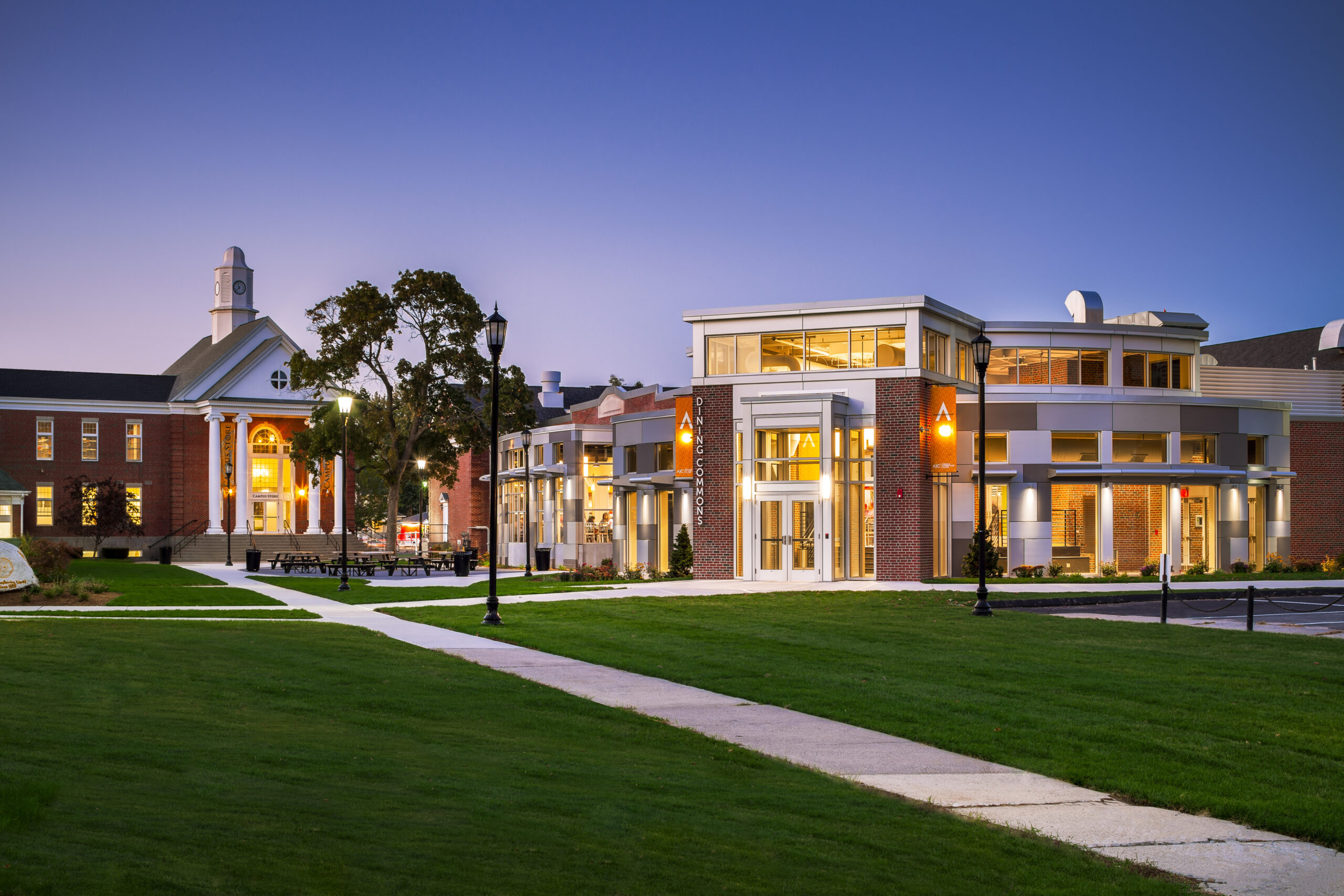
Higher Education institutions are asking for sophisticated energy-saving tactics, green infrastructure, and design that promotes learning to the highest degree. At Colliers Engineering & Design, we’re taking stock of the current state of the education market, making connections, and leading projects that are disrupting the status quo.
While sustainability benefits every client, our education clients generally have to plan not only for the next decade or two, but for what will be beneficial (and in compliance) in 50, or even 100 years from now. They are also home to the next generation of stewards of our environment. This all puts them in a unique position to care about sustainability when designing and redesigning buildings.
Sustainability In Action

Nestled in the center of Massachusetts, UMass Amherst’s picturesque campus is taking a major step forward in sustainable design and construction. Colliers Project Leaders, a division of Colliers Engineering & Design, is providing owner’s project management services for the University’s Manning College of Information and Computer Sciences (CICS) new 90,000 square-foot Computer Science Laboratories (CSL) building.
Designed to support UMass Amherst’s Carbon Zero initiative, the CSL building features a mass timber superstructure that significantly mitigates its carbon footprint. Mass Timber buildings are more sustainable than metal ones like steel. Sustainably harvested timber is renewable, whereas metal is not. Also, the trees absorb carbon as they grow, resulting in Carbon Sequestration, which means there is less carbon in our atmosphere.
“Steel and concrete use more energy to produce than timber,” Adam explained. “The basic process is that trees just need to be planted, cut down and milled, and then reassembled or laminated into structural members. The strength of Cross-Laminated Timber is just as strong as steel, but you get all these other sustainability benefits.”
Specifically, use of mass timber is expected to lower embodied carbon by 60 percent and the overall design will reduce operational energy use by more than 40 percent compared to conventional academic buildings. UMass Amherst targeted, and the project achieved LEED Platinum certification, the highest level of certification awarded by the U.S. Green Building Council (USGBC) for sustainable design, to reinforce the University’s commitment to energy efficiency and long-term climate stewardship.
Walking the Walk While Talking the Talk

Beyond its sustainable construction, the facility is designed to foster collaboration, innovation, and hands-on learning. The building will house specialized robotics and fabrication labs, classrooms, and a 240-seat auditorium organized around a multi-story commons. Integrated maker spaces provide students with 3D printers, laser cutters, and other advanced tools to bridge the gap between digital theory and physical experimentation. The school also offers a Mass Timber Engineering Program, along with a core curriculum for engineering students who are there specifically learning to design with mass timber. The CICS Computer Science Laboratories are a model for how forward-thinking academic spaces can advance research and learning while significantly reducing environmental impact.
“When we integrate sustainability into school projects, we establish a new standard for the students who will occupy the spaces,” shared Senior Manager of Sustainability Patricia Hunold. “We’re giving them a high-performance environment they can learn from as a living lab designed to maximize their cognitive focus and long-term health.”
Patricia believes the architecture of the building should mirror the ambition of the students within. “Shouldn’t spaces meant to foster the minds of future engineers reflect the very innovation that will inspire them?” she asks. “And shouldn’t those students have the opportunity to take ownership of the environments where they learn?”
Sustainable Design Benefits Everyone
With nearly 80% of Gen Z reporting that they are “extremely worried about current and future harm to the environment caused by human activity and climate change,” students, whom colleges and universities are competing to attract, are motivated to choose their schools based on their sustainability practices. As a result, when schools use their buildings as living labs like UMass Amherst does, students are more inclined to enroll in courses that enable them to learn directly from these real-world applications.
Educational institution administrators know that building design has a direct impact on students. Research indicates that “students learning in naturally lit environments typically achieve grades that are 25% higher than those in dimly lit classrooms,” largely because daylight boosts mood and significantly reduces stress and anxiety. And beyond students well-being and performance, sustainability benefits schools’ budgets too. Using natural light is environmentally responsible, and reducing reliance on artificial lighting lowers energy costs, delivering long-term cost savings.
“From an operational standpoint, sustainability is good stewardship of public or institutional funds because every dollar that we save through high efficiency HVAC systems or high-performance building envelope, is money that can be redirected to teacher salaries, classroom technology, or whatever else is needed,” explained Patricia. She emphasizes that these design choices affect the total cost of ownership. “A university may invest more in sustainable systems upfront, but the long-term savings in maintenance and energy are substantial.”
The impact also extends beyond the campus gates. By preparing for extreme weather, a school can serve as a vital community asset. “When we combine solar arrays with battery storage to create a microgrid, a school can remain powered during a grid failure,” Patricia adds. “This allows the campus to serve as a resilience hub, a cooling center or emergency shelter for the surrounding neighborhood during a crisis.”
Construction Choices

When you think of sustainability, you may only think about a newly built product. But administrations understand that their existing building stock play a critical role in the overall sustainability of their building assets and often aim for increased energy efficiency in their renovation projects without sacrificing any of the character and charm that makes a historical building unique. Joshua Swasey, Senior Architect | Architecture, is an expert in ensuring that each phase of a project is done in an environmentally conscious way, whether a building is new or existing. He also embraces the context and history of a building and uses existing materials to help celebrate its history.
“There are usually many beautiful elements of a building that can be repurposed and reused if thought about at the front-end of a project,” Joshua explained. “You can take stock of everything within the building and then use that as part of the design inspiration going forward.”
This means that while some elements may not be universally accessible and may not meet current code, these elements can still be preserved and reused for different applications, respecting the original beauty and character while bringing the design/project up to current standards.
Josh continued, “On one project, we laid out all the salvaged light fixtures in one room and took stock with the client. Collectively we said, okay what do we think we should be reusing so that way we can meet the sustainability goals? Maybe a light-fixture needs to be re-lamped to have LED instead of incandescent. You reuse things that are old but make them new again in a meaningful way.”
“In another example,” he continued, “you can take striking pink marble partitions, which you just can’t get anymore, especially at an inch and a half thickness, and reuse them as part of our window surrounds. By stepping out of your comfort zone and considering how existing materials can be reused, you can honor their history, reduce costs for the client, and contribute positively to the environment.”
Deconstruction also offers ample opportunities for sustainable practices. “Typically, in a renovation, you go in, rip everything out, put it in a dumpster, haul it away, and you never look at it again, right? But there’s another way. If you carefully disassemble, not demolish, things, materials and building elements can be salvaged and sent to somebody else for reuse if you don’t have use for it. I have had luck partnering with local third-party vendors who may be able to take materials. Doors, brass knobs, sinks, faucets, random things that you would think nobody would have a use for, but you’d be very surprised if you think outside of the box and outside of typical waste stream diversion,” Josh explained.
The Long View
Our professionals have extensive national expertise to ensure we not only build to the current code in our clients’ current jurisdiction but also anticipate future trends in code requirements. They also transfer knowledge gained from work in places with stricter requirements and apply this knowledge to assist our clients in making decisions that will benefit them for decades.
Adam Troidl, Senior Project Manager| Project Management and the head of our Green Team shared, “We could design a code-minimum building in a particular state, but probably in a few years there’s going to be new legislation about energy-reporting, carbon emissions, or new fines, and you’ll have to spend time and money redoing systems or paying perpetual fines.” Areas without legislation like Boston’s Building Emissions Reduction and Disclosure Ordinance (BERDO) or New York’s Local Law 97, a plan for reducing emissions, will likely see requirements emerge, while Boston and New York heighten theirs over time.
Also unique about higher education clients is that many have campuses and satellite campuses, or own buildings in different regulatory environments. Our national experience has given us insight as to how we handle these situations, since regulations require entities to report on their sustainability for everything they own, not just what’s in one city or state.
We Work With You
Whether you are a college or university pursuing sustainability goals, working toward specific certifications, meeting required reporting compliance standards seeking to attract environmentally conscious students, or even just exploring ways to cut costs long-term, our experts understand that each project is unique. We take the time to get to know you, your students, and your priorities to ensure your goals are met.
With an eye on the latest technologies and trends, and deep experience making schools more sustainable nationwide, our team is helping to build up tomorrow’s leaders, one school at a time.
Contact Patricia Hunold, Joshua Swasey, or Adam Troidl via email for more information.