Prospect Mountain Interchange: Rebuilding Binghamton’s Busiest Crossroads
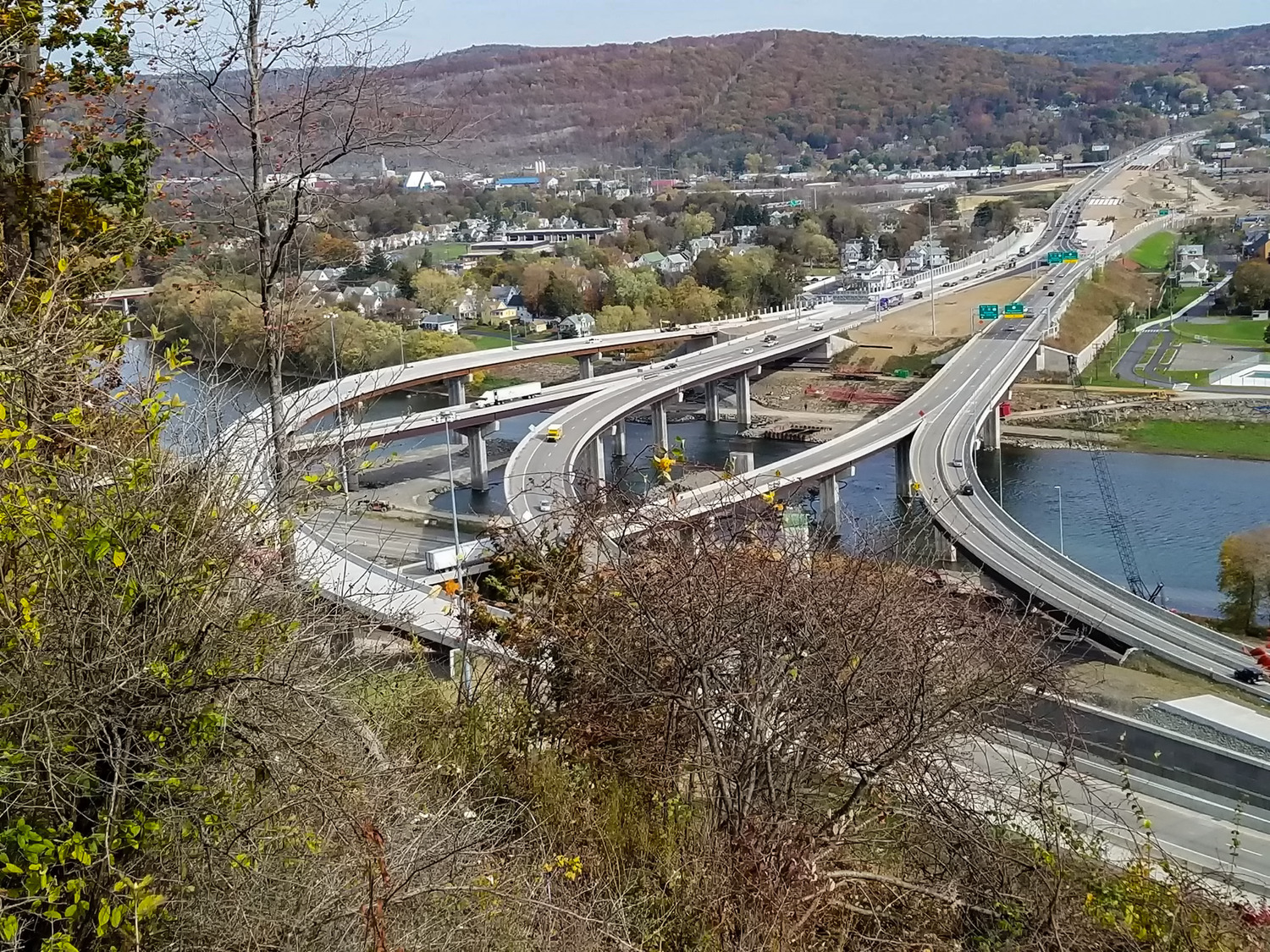
In Binghamton, where I-81 and NY Route 17 converge alongside and across the Chenango River, the Prospect Mountain interchange has long been one of the Southern Tier’s most critical and complex transportation nodes. Our team provided final design for the $152 million second phase of this large-scale interchange reconstruction, building on Phase I improvements to address the remaining operational and safety deficiencies and bring the corridor up to interstate standards as part of the future I-86 designation.
The scope reflects the scale of the challenge. Phase II involved the reconstruction and reconfiguration of the interchange with NYS Route 7, including the design of six major bridges and modifications to one existing bridge, reconstruction of US 11 and NYS Route 7, and installation of over two miles of noise barrier. The project also called for 2,800 linear feet of new retaining walls, several new traffic signals, and the construction of a multi-use path along US 11 that connects travelers to the broader sidewalk and trail network along the Chenango River.
Intelligent Systems, Complex Staging, Seamless Execution
State-of-the-art Intelligent Transportation Systems features were integrated throughout the project limits, including closed-circuit television cameras, highway advisory radio, and permanent variable message signs. These tools give NYSDOT the ability to actively manage traffic and communicate with drivers in real time, long after construction wraps.
Keeping nearly nine miles of active highway functional during reconstruction demanded equally sophisticated staging. Complex work zone traffic control measures incorporated the installation of a 960-foot-long temporary highway bridge, allowing traffic to keep moving while the team rebuilt the interchange beneath and around it. It’s the kind of problem-solving that only comes from understanding that infrastructure serves people first, and every decision has to reflect that.